Tag Archives: sudoku

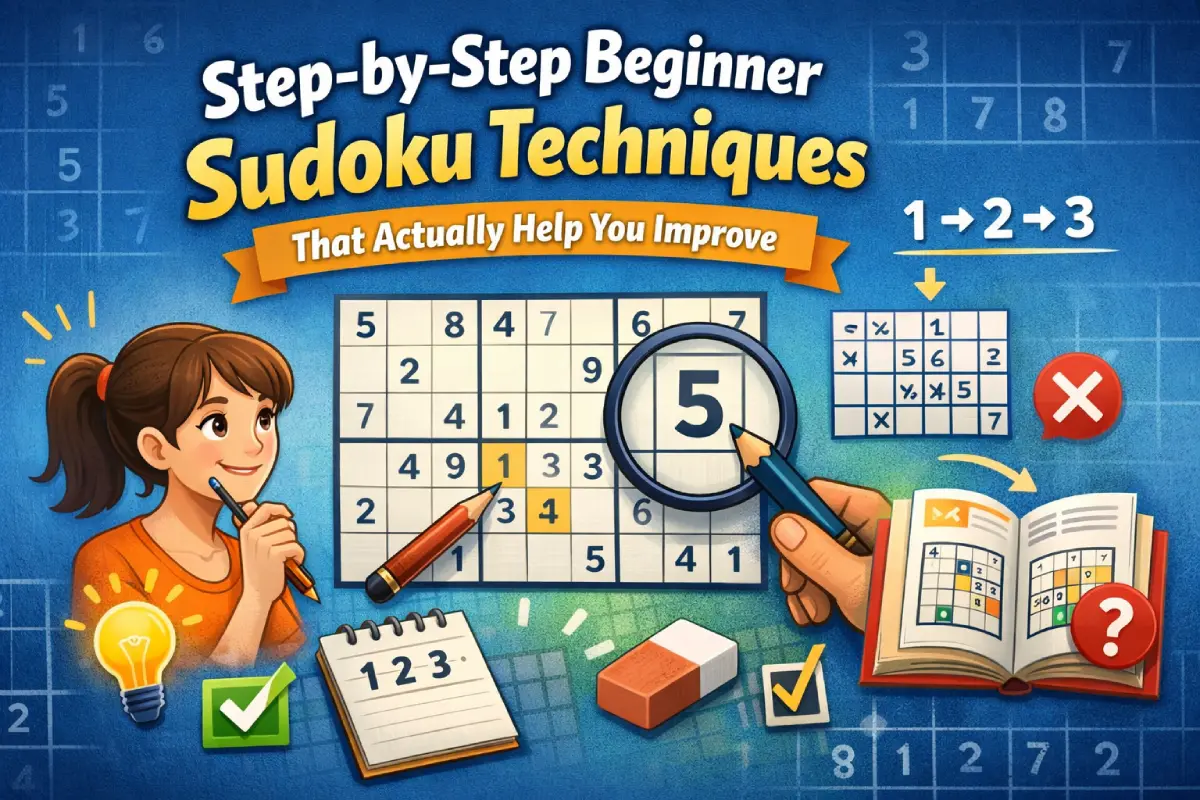
Step-by-Step Beginner Sudoku Techniques That Actually Help You Improve

Have you ever stared at a Sudoku grid, pencil in hand, completely baffled about where to begin? You’re not alone. Sudoku, with its simple 9×9 grid and deceptively simple rules, can feel overwhelming to beginners.

Many give up after a few frustrating attempts, convinced they lack the “logic gene.” But here’s the truth: Sudoku isn’t about innate genius; it’s about learning and applying specific, repeatable techniques.

This guide walks you through step-by-step beginner Sudoku techniques that form the foundation of all successful solving. Master these, and you’ll move from confused beginner to confident solver.


The Sudoku Foundation: Rules You Must Know

A standard Sudoku puzzle is a 9×9 grid divided into nine 3×3 boxes. Everything you do in Sudoku follows these three rules:

  • Row Rule: Each row must contain numbers 1–9 with no repetition.
  • Column Rule: Each column must contain numbers 1–9 with no repetition.
  • Box Rule: Each 3×3 box must contain numbers 1–9 with no repetition.

Every technique below is simply a smarter way to apply these rules.


Step-by-Step Beginner Sudoku Techniques

Technique 1: Scanning & Cross-Hatching (Your Starting Point)

This is the first technique you should use in every Sudoku puzzle. Instead of guessing, you scan the grid logically.

  1. Choose a target number: Start with a number that appears frequently.
  2. Scan rows and columns: Look at where that number already exists.
  3. Eliminate blocked cells: Cross out cells where the number cannot go.
  4. Place the forced number: If only one cell remains, fill it in.

Action Tip: Try scanning for the number 1 on your next puzzle. You’ll often fill several cells immediately.


Technique 2: Single Candidate (Only Choice)

This technique focuses on one empty cell at a time.

  1. Select an empty cell.
  2. Check its row, column, and box.
  3. Eliminate used numbers.
  4. Fill the only remaining number.

If eight numbers are blocked, the remaining one must be correct. This is one of the most powerful beginner Sudoku strategies.


Technique 3: Single Position (Hidden Single)

Instead of looking at a cell, this technique looks at a row, column, or box.

  1. Choose a unit: One row, column, or 3×3 box.
  2. Select a missing number.
  3. Eliminate impossible cells.
  4. Find the only valid position.

Pro Tip: This technique is especially effective inside 3×3 boxes, where rows and columns restrict placements.


Putting It All Together: A Beginner’s Sudoku Strategy

Use these techniques in a simple cycle:

  • Scan & Cross-Hatch the grid
  • Find Single Candidates
  • Look for Single Positions
  • Repeat the cycle after each placement

Each new number creates more opportunities for the next move.


Common Beginner Sudoku Mistakes to Avoid

  • Guessing: Sudoku is pure logic.
  • Ignoring pencil marks: Notes prevent mistakes.
  • Staring at one spot too long: Move around the grid.
  • Giving up early: Every valid puzzle is solvable.

Your Practice Path to Improvement

Week 1–2: Play easy Sudoku puzzles and master scanning.
Week 3–4: Move to medium puzzles and use pencil marks.
Beyond: Try harder puzzles and prepare for advanced techniques.


Ready to Start Solving?

Remember this simple formula: Scan → Single Candidate → Single Position → Repeat

Sudoku mastery is a journey. By learning these beginner techniques, you’re building a strong logical foundation that makes every future puzzle easier.

The grid isn’t your enemy — it’s your playground.


Want the next level? Subscribe to our newsletter to get notified when we publish Intermediate Sudoku Strategies: Moving Beyond the Basics.

How Long Does Sudoku Take?

One of the most common questions Sudoku players ask is: how long does Sudoku take to solve? Understanding Puzzle Time Challenges. The answer depends on several factors, including puzzle difficulty, grid size, and the solver’s experience level.

In this guide, Sudokuo breaks down Sudoku solving times realistically, helping you set accurate expectations—whether you’re a beginner or an experienced player chasing faster completion times.


What Affects Sudoku Solving Time?

Sudoku is a logic puzzle, not a speed game by default. Completion time varies based on:

  • Difficulty level of the puzzle
  • Grid size (4×4, 9×9, 12×12)
  • Player experience and technique
  • Use of logic vs guessing

A logically solved puzzle may take longer but results in fewer mistakes and stronger skills.


Average Sudoku Solving Time by Difficulty

The table below shows typical completion times for a standard 9×9 Sudoku puzzle:

DifficultyAverage Time
Easy5–10 minutes
Medium10–20 minutes
Hard20–40 minutes
Expert40–60+ minutes
Extreme60–90+ minutes

These times assume logic-based solving without guessing, which is how well-designed Sudoku puzzles are meant to be completed.

You can experience different difficulty levels directly on:


Sudoku Solving Time by Player Level

Beginners

New players often take longer because they are learning to recognize patterns and apply basic elimination techniques. Early puzzles may take 30 minutes or more, even at easy levels.

Intermediate Players

With experience, players develop faster scanning and candidate elimination skills. Medium puzzles often take 10–15 minutes.

Advanced and Expert Players

Experienced solvers rely on structured logic and advanced techniques. While puzzles are harder, they often solve them more efficiently, focusing on accuracy over speed.


Does Grid Size Change Solving Time?

Yes—larger grids increase complexity significantly.

  • 4×4 Sudoku: Often solved in under 5 minutes
  • 9×9 Sudoku: Standard time ranges apply
  • 12×12 Sudoku: Can take 60 minutes or more

Larger grids require deeper concentration and multi-step logic chains.


Is Faster Always Better in Sudoku?

Speed does not equal skill in Sudoku.
Logical accuracy is the true measure of mastery.

Rushing often leads to mistakes that cost more time later. Many expert solvers prefer steady, logical progress rather than speed-focused solving.


How Sudokuo Helps You Track and Improve Time

Sudokuo offers:

  • Balanced puzzle difficulty
  • Clear grids for focused solving
  • Progressive challenges that improve speed naturally

You can practice efficiently here:


Final Thoughts

So, how long does Sudoku take?
There is no single answer—but understanding difficulty, grid size, and personal skill level helps set realistic expectations.

Sudoku is best enjoyed as a mental workout, not a race. With regular practice and logical techniques, your solving time will naturally improve—without sacrificing accuracy.

How to Solve Sudoku Without Guessing

Introduction

Have you ever been stuck on a Sudoku puzzle simply staring at the grid, thinking the only way forward is to make a wild guess? Don’t worry, you’re not alone. Almost all beginners think that Sudoku requires guessing. However, the reality is, every Sudoku puzzle can be solved logically without relying on luck the question is How to Solve Sudoku Without Guessing.

Sudoku is more than just putting numbers in boxes — it is a test of patience, observation, and logical reasoning. By learning Sudoku solving techniques and practicing logic-based strategies, you will improve your puzzle speed and enjoy the satisfaction of solving even the hardest Sudoku puzzles without having to guess.

In this guide, we are going to take you through success-based, step-by-step Sudoku solving techniques which challenge your brain while guaranteeing success .


Step 1: Begin with the Obvious – Scanning

The first and easiest technique for a beginner is to scan. Scanning means looking across rows, columns, and 3×3 boxes at once to identify missing numbers.

👉 Example: If you see the number 5 in two different rows of a 3×3 box, then the only place left for 5 is the open space in that box.

✅ Quick and easy – always your first step when starting a puzzle.


Step 2: Pencil Marks – Your Secret Weapon

Many professional Sudoku solvers use pencil marks (or notes). These are small candidate numbers written inside cells.

  • As you eliminate candidate options, the notes shrink.
  • Eventually, only the correct number remains.

✍️ Pencil markings are crucial for avoiding blind guessing and are an essential tool for step-by-step solving.


Step 3: Naked Singles and Hidden Singles

Naked Single

When a cell has only one candidate left, it must be the solution.

Hidden Single

When a number can only fit in one location in a row, column, or box — even if other candidates exist.

⚡ These tactics may sound technical, but with practice, they become second nature.


Stage 4: Pairs and Triples

Naked Pairs/Triples

If two (or three) cells in a unit (row, column, or box) can only contain the same numbers, eliminate those numbers from the other cells in that unit.

Hidden Pairs/Triples

If two or three numbers are restricted to the same cells, you can remove other candidates from those cells.

🔑 These techniques expand your logic-based solving tools for tougher puzzles.


Stage 5: Advanced Elimination – X-Wing and Swordfish

X-Wing

  • A number appears in two positions in two different rows, aligned in the same columns.
  • You can then eliminate that number from other cells in those columns.

Swordfish

  • An advanced version of X-Wing using three rows and three columns.

💡 While advanced, these strategies allow you to solve extremely tough puzzles without guessing.


Comparison Chart: Sudoku Solving Methods

MethodDifficulty LevelWhen to Use
ScanningEasyAt the start of every puzzle
Pencil MarksEasyThroughout the puzzle for options
Naked/Hidden SinglesEasy–MediumEarly to mid-game
Naked/Hidden PairsMediumWhen singles are not enough
X-WingHardAdvanced puzzles
SwordfishExpertWhen no other option works

This chart simplifies when to apply Sudoku-solving methods at each stage.


Step 6: Practice Patience and Observation

Sudoku is not a speed test — it’s a mental exercise. Keep these in mind:

  • 🧘 If you feel stuck, take a break.
  • 🔄 Re-evaluate your previous moves.
  • 🚫 Never rush a guess — there’s always a logical path forward.

By consistently applying these step-by-step Sudoku solving methods, you can unlock any puzzle without guessing.


FAQs – How Do I Solve Sudoku Without Guessing?

1. Can every Sudoku puzzle be solved without guessing?
Yes! Well-designed puzzles have a unique logical solution. Use singles, pairs, and advanced strategies if you get stuck.

2. What is the easiest strategy for logic-based Sudoku?
Scanning. Combine it with pencil marks for the best start.

3. How do I improve step-by-step Sudoku solving?
Practice! Start with easy puzzles, then move to medium and hard. Master one technique at a time.

4. Do all puzzles require advanced strategies like X-Wing?
No. Easy and medium puzzles can be solved with basic techniques. Advanced strategies are mostly for hard or expert-level puzzles.


Conclusion

Yes, you can solve Sudoku without guessing, and it’s much more satisfying! By learning and applying logic-based strategies such as scanning, singles, pairs, and advanced elimination techniques, you’ll be able to approach every puzzle with confidence.

Next time you sit down with a grid, remember:
✨ It’s not luck — it’s logic.

Now grab a fresh Sudoku puzzle and put these strategies to work — your brain will thank you!