
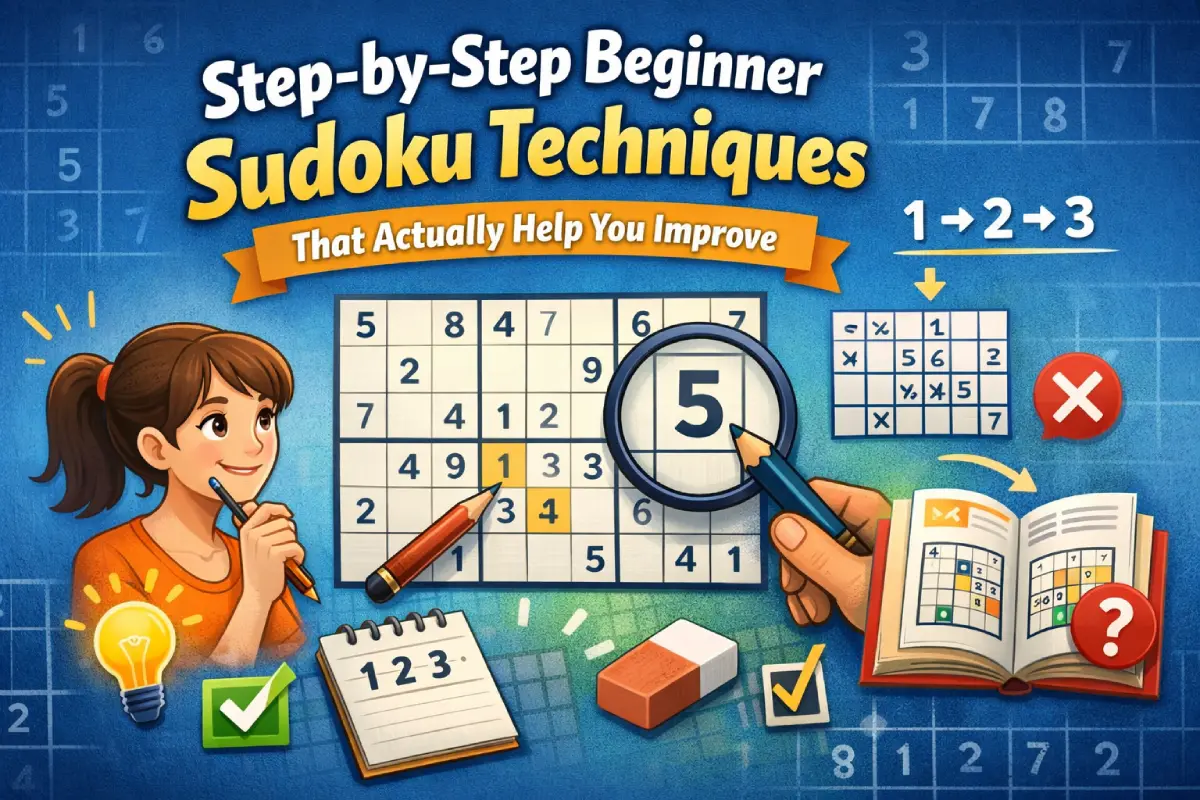
Have you ever stared at a Sudoku grid, pencil in hand, completely baffled about where to begin? You’re not alone. Sudoku, with its simple 9×9 grid and deceptively simple rules, can feel overwhelming to beginners.
Many give up after a few frustrating attempts, convinced they lack the “logic gene.” But here’s the truth: Sudoku isn’t about innate genius; it’s about learning and applying specific, repeatable techniques.
This guide walks you through step-by-step beginner Sudoku techniques that form the foundation of all successful solving. Master these, and you’ll move from confused beginner to confident solver.
The Sudoku Foundation: Rules You Must Know
A standard Sudoku puzzle is a 9×9 grid divided into nine 3×3 boxes. Everything you do in Sudoku follows these three rules:
- Row Rule: Each row must contain numbers 1–9 with no repetition.
- Column Rule: Each column must contain numbers 1–9 with no repetition.
- Box Rule: Each 3×3 box must contain numbers 1–9 with no repetition.
Every technique below is simply a smarter way to apply these rules.
Step-by-Step Beginner Sudoku Techniques
Technique 1: Scanning & Cross-Hatching (Your Starting Point)
This is the first technique you should use in every Sudoku puzzle. Instead of guessing, you scan the grid logically.
- Choose a target number: Start with a number that appears frequently.
- Scan rows and columns: Look at where that number already exists.
- Eliminate blocked cells: Cross out cells where the number cannot go.
- Place the forced number: If only one cell remains, fill it in.
Action Tip: Try scanning for the number 1 on your next puzzle. You’ll often fill several cells immediately.
Technique 2: Single Candidate (Only Choice)
This technique focuses on one empty cell at a time.
- Select an empty cell.
- Check its row, column, and box.
- Eliminate used numbers.
- Fill the only remaining number.
If eight numbers are blocked, the remaining one must be correct. This is one of the most powerful beginner Sudoku strategies.
Technique 3: Single Position (Hidden Single)
Instead of looking at a cell, this technique looks at a row, column, or box.
- Choose a unit: One row, column, or 3×3 box.
- Select a missing number.
- Eliminate impossible cells.
- Find the only valid position.
Pro Tip: This technique is especially effective inside 3×3 boxes, where rows and columns restrict placements.
Putting It All Together: A Beginner’s Sudoku Strategy
Use these techniques in a simple cycle:
- Scan & Cross-Hatch the grid
- Find Single Candidates
- Look for Single Positions
- Repeat the cycle after each placement
Each new number creates more opportunities for the next move.
Common Beginner Sudoku Mistakes to Avoid
- Guessing: Sudoku is pure logic.
- Ignoring pencil marks: Notes prevent mistakes.
- Staring at one spot too long: Move around the grid.
- Giving up early: Every valid puzzle is solvable.
Your Practice Path to Improvement
Week 1–2: Play easy Sudoku puzzles and master scanning.
Week 3–4: Move to medium puzzles and use pencil marks.
Beyond: Try harder puzzles and prepare for advanced techniques.
Ready to Start Solving?
Remember this simple formula: Scan → Single Candidate → Single Position → Repeat
Sudoku mastery is a journey. By learning these beginner techniques, you’re building a strong logical foundation that makes every future puzzle easier.
The grid isn’t your enemy — it’s your playground.
Want the next level? Subscribe to our newsletter to get notified when we publish Intermediate Sudoku Strategies: Moving Beyond the Basics.