How to Solve Sudoku Without Guessing
How to Solve Sudoku Without Guessing Using Logical Techniques. Sudoku is often misunderstood as a game of trial and error. In reality, a properly designed Sudoku puzzle never requires guessing. Every solution can be reached using logic alone. Learning how to solve Sudoku without guessing helps you play more confidently, reduce mistakes, and enjoy the puzzle as it was intended.
At Sudokuo, puzzles are structured to reward logical thinking, not luck—making it the perfect place to practice skill-based solving.
Why Guessing Holds Players Back
Guessing may seem like progress, but it often causes hidden errors that surface much later in the puzzle. Logical solving, on the other hand:
- Ensures every move is correct
- Builds consistent solving habits
- Scales naturally to harder puzzles
- Improves long-term skill development
Professional Sudoku creators design puzzles so that logic is always sufficient—even at expert and extreme levels.
The Logical Foundation of Sudoku
Sudoku logic is based on one simple principle:
Each number must appear once per row, once per column, and once per box.
From this structure, all logical techniques emerge through candidate elimination, not assumptions.
To understand the mathematical foundation behind Sudoku, you can explore this authoritative explanation on Wikipedia:
https://en.wikipedia.org/wiki/Sudoku
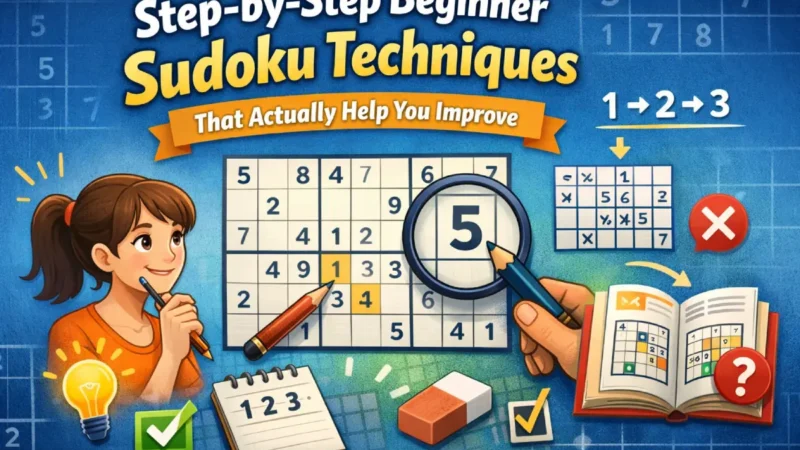
1. Candidate Elimination (Core Technique)
Instead of guessing what might work, logical solvers identify what cannot work.
For any empty cell:
- Remove numbers already present in the same row
- Remove numbers in the same column
- Remove numbers in the same box
If only one candidate remains, the solution is guaranteed.
This technique alone can solve most easy and medium puzzles, including those found at:
https://sudokuo.com/medium
2. Naked Singles and Hidden Singles
A naked single occurs when a cell has only one possible number left.
A hidden single is more subtle—it appears when a number can fit in only one cell within a row, column, or box, even if that cell has multiple candidates.
These techniques are essential for progressing beyond beginner levels and are frequently required in:
https://sudokuo.com/hard
3. Box–Line Interaction
This logical method observes how rows, columns, and boxes influence each other.
If a number can only appear in one row within a box, it cannot appear elsewhere in that row outside the box. This interaction unlocks stalled puzzles without guessing and is commonly used in expert-level grids.
You’ll encounter this logic often in:
https://sudokuo.com/expert
4. Naked Pairs and Structured Logic
When two cells in the same unit share the exact two candidates, those candidates can be removed from all other cells in that unit. This applies similarly to triples at higher difficulties.
These patterns require patience and careful observation but are entirely logical—not speculative.
Practicing Logic the Right Way
Sudokuo is designed to support logical improvement:
- Clean, distraction-free grids
- Balanced difficulty progression
- Multiple grid sizes for skill expansion
For quick logical warm-ups or advanced thinking, explore:
https://sudokuo.com/
Final Thoughts
Solving Sudoku without guessing is not about memorizing tricks—it’s about training your reasoning process. By mastering elimination, singles, and structured logic, you can approach any Sudoku puzzle with clarity and confidence.
When logic leads every move, Sudoku becomes more than a game—it becomes a skill.
Practice logic. Eliminate guessing. Improve steadily with Sudokuo.